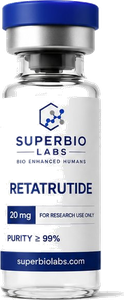
Retatrutide
Research peptideTriple GLP-1/GIP/glucagon agonist · phase 3 complete · up to 28.3% weight loss at 80 weeks (30.3% at 2 years)
Overview
What has it been researched for?
- Controls appetite and satiety Main focusStrong evidence
- Lowers body weightStrong evidence
- Reduces liver fatStrong evidence
- Improves glucose controlStrong evidence
- Improves lipids and blood pressureStrong evidence
- Raises energy expenditureEarly evidence
- Reduces sleep apneaStrong evidence
- Less joint painStrong evidence
- Slower pace of agingEarly evidence
Research protocols
The SBL research protocol and what the literature reports. Not medical advice.
SBL research protocol · no established clinical regimen in people
- Dose
- 1.5 → 3 mg
- Frequency
- 1×/semana
- Duration
- 16 weeks
- Route
- Subcutaneous
- Evidence level
- Human study
Tools
Evidence and studies
See studies →Protocols
Research protocols
SBL research protocol · no established clinical regimen in people
Research use, with no established clinical regimen in people.
- Dose
- 1.5 → 3 mg
- Frequency
- 1×/semana
- Timing
- cualquier hora
- Duration
- 16 weeks
- Break
- No break
- Route
- Subcutaneous
- Evidence level
- Human study
Example dose
100-unit U-100 insulin syringe · Starting dose of its protocol, with 1 ml of water in the 10 mg vial.
100-unit U-100 insulin syringe · Starting dose of its protocol, with 2 ml of water in the 20 mg vial.
What it pairs with
- Tirzepatidedoes not pair
- MOTS-cpairs well
Preparation and dosing
Quick reference
Preparation
- Diluent
- Bacteriostatic water
Evidence
Each effect with its evidence level and, where available, its source.
- Controls appetite and satietyHuman studySee study · 2025
- Lowers body weightPhase 3See study · 2026
- Reduces liver fatHuman studySee study · 2024
- Improves glucose controlPhase 3See study · 2026
- Improves lipids and blood pressurePhase 3See study · 2026
- Raises energy expenditurePreclinicalSee study · 2022
- Reduces sleep apneaPhase 3See study · 2026
- Less joint painPhase 3See study · 2026
- Slower pace of agingExtrapolatedSee study · 2026
The science
Mechanisms, studies and references
Triple agonist
Safety
It makes sense if you want
- Lose weight — most potent
- Lose weight & curb appetite
- Longevity & deep anti-aging
It does not make sense if
- Personal or family history of medullary thyroid cancer or MEN2
- Active cancer or oncology treatment in the last 5 years
- Pregnancy or breastfeeding
- Gastroparesis or slow gastric emptying
- Active eating disorder
Talk to your doctor first if this applies (17)
- Oral contraceptive (the pill)
- Severe heart disease or recent cardiac event
- Major surgery in the last 3 months
- Type 1 diabetes
- Type 2 diabetes / prediabetes
- Gallbladder disease or gallstones
- GLP-1 (Ozempic, Wegovy, Mounjaro, Saxenda)
- Severe liver impairment
- Severe kidney impairment
- Insulin
- Blood pressure meds
- Thyroid meds
- History of pancreatitis
- Planning a pregnancy in the next 3 months
- Diabetic retinopathy
- Sulfonylureas / metformin
- Thyroid disorder
The certificate of analysis (CoA) certifies the identity and purity of the batch. It does not certify safety of use.
Verify your batch →For research use only (RUO). This consult is educational and does not replace your doctor.
Questions
Frequently asked questions
What is it reconstituted with, and how much?
With bacteriostatic water: 1 ml into the 10 mg vial, giving 10 mg/ml.
What is the starting dose of the research protocol?
1.5 → 3 mg, 1×/semana. This is the SBL research protocol, with no established clinical regimen in people.
How long is the cycle, and how long does a vial last?
16 weeks. At the starting dose, the 10 mg vial lasts ~3 sem.
Which route is used in research?
Subcutaneous.
When does it make no sense?
It makes no sense with: Personal or family history of medullary thyroid cancer or MEN2, Active cancer or oncology treatment in the last 5 years, Pregnancy or breastfeeding, Gastroparesis or slow gastric emptying, Active eating disorder. Details in the Safety tab.
What is it combined with?
It goes well with MOTS-c. The reasons are in the Protocols tab.
How do I check my batch?
With the code on the vial, in the verifier. The CoA certifies the identity and purity of the batch, not safety of use.
For research use only (RUO). This consult is educational and does not replace your doctor.