We organize our catalog by biological function: individual peptides and blends across 9 series. Each series includes individual peptides and pre-mixed blends (vials with 2-4 peptides in validated proportions). What is a blend →
GLP-1/GIP/glucagon agonists + AMPK mitochondrial peptide. Modern multi-pathway metabolic stack.
The Metabolic Series covers the most studied and commercially successful molecules of the past decade in weight control and type 2 diabetes: GLP-1 receptor agonists. They work by mimicking a gut hormone the body releases after meals, slowing gastric emptying, suppressing appetite at the hypothalamic level, and improving pancreatic insulin sensitivity.
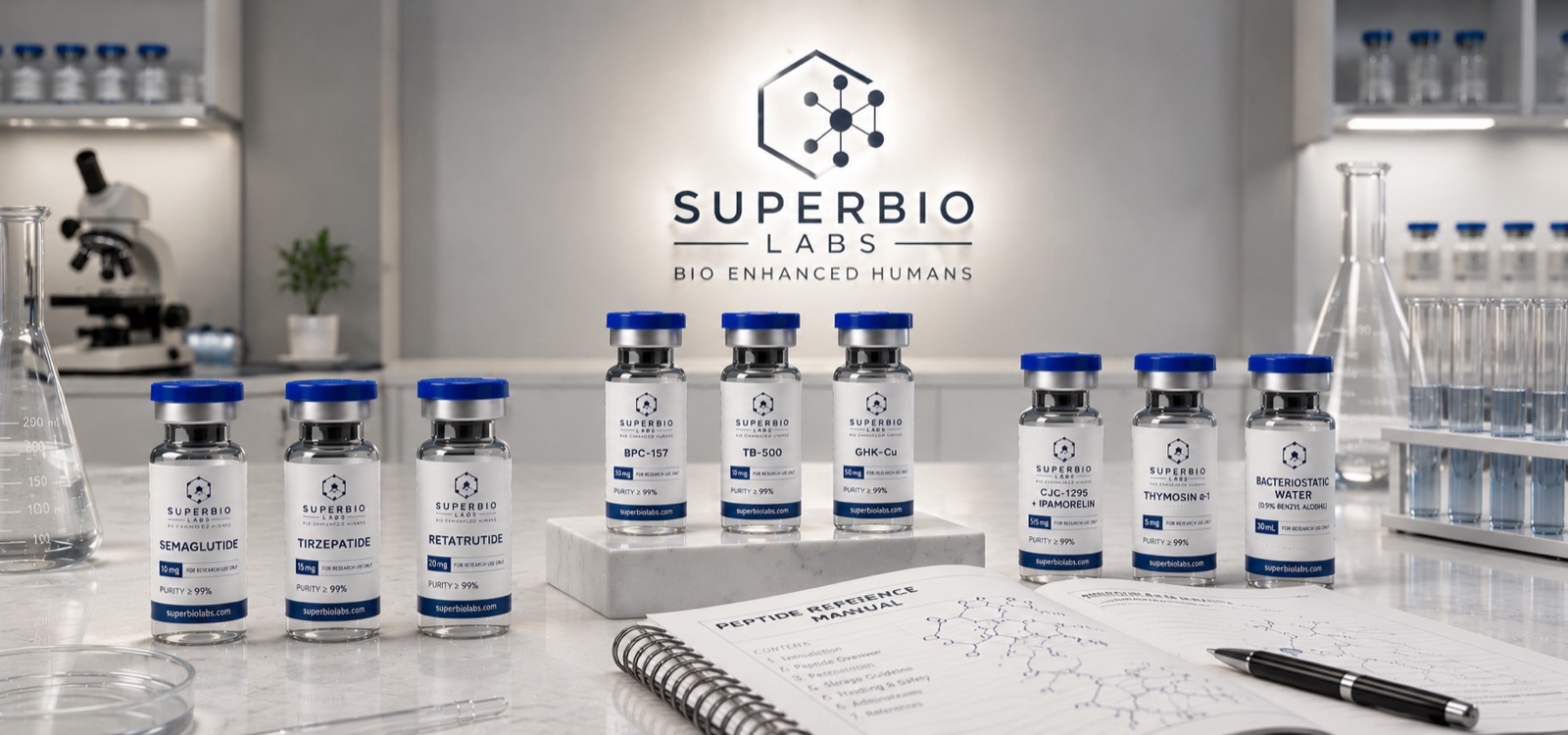
Each generation adds a mechanism: Semaglutide is a mono-agonist (GLP-1 only), FDA-approved for obesity in 2021 with average 14.9% body weight reduction over 68 weeks. Tirzepatide is dual (GLP-1 + GIP), approved 2023, 22.5% reduction. Retatrutide is triple (GLP-1 + GIP + glucagon), still in Phase III, but its Phase II reported 24.2% reduction over 48 weeks — the highest figure on record in its category.
Typical use: research in obesity, insulin resistance, metabolic syndrome, NAFLD. Subcutaneous application 1×/week. Choice between the three depends on the goal: Semaglutide to enter gradually, Tirzepatide for consolidated results, Retatrutide for frontier research with the highest upside.
WOLVERINE combines BPC-157 + TB-500 in a single blend: local + systemic repair. BPC-157 alone for highly localized injuries.
The Recovery Series brings together the two most-used molecules in tissue regeneration and high-performance sports: BPC-157 (Body Protection Compound) and TB-500 (Thymosin β-4 fragment). They work via complementary mechanisms — BPC-157 accelerates local angiogenesis and healing of tendons, ligaments, gastric mucosa, and neural tissue; TB-500 modulates cellular actin, facilitating stem-cell migration to injury sites.
BPC-157 is a pentadecapeptide isolated from human gastric juice. Over 100 animal-model papers document effects on musculoskeletal injuries, ulcers, and neural repair. TB-500 is the synthetic version of the active residue of Thymosin β-4, a protein present in virtually every cell in the body.
Typical use: research in chronic sports injuries, post-surgical recovery, tendon damage, inflammatory bowel conditions. Often stacked in 4–8 week protocols: BPC-157 daily, TB-500 twice weekly. It's been the reference combination in biohacker literature since 2015.
From skin regeneration (GHK, GLOW, KLOW) to systemic longevity with telomerase activation (Epithalon). The most complete category in the catalog.
The Longevity Series is one of the oldest in the peptide category and, paradoxically, the one experiencing the strongest scientific renaissance. GHK-Cu (Glycyl-Histidyl-Lysine + copper ion) was identified in 1973 by researcher Pickart in human plasma, where its concentration drops approximately 60% between ages 20 and 60. This decline correlates with many aging markers.
GHK-Cu's mechanism is multifaceted: it modulates expression of more than 4,000 genes (per Pickart 2018 transcriptomic analysis), including DNA repair genes, endogenous antioxidants, and type III collagen production. It has applications in both topical use (premium cosmetics, where it dominates anti-aging formulations from brands like SkinMedica) and systemic research (subcutaneous or sublingual).
Typical use: research in skin regeneration, hair quality, cellular antioxidation, inflammatory modulation. GHK-Cu's appearance is naturally blue from copper chelation — the only molecule in the catalog with visible color. Applied daily in 30–60 day cycles.
Tesamorelin stimulates endogenous GH. PT-141 acts on the sexual axis via melanocortin. Hormonal optimization in the broadest sense.
The Hormonal Series addresses one of the most studied endocrine axes in aging: the somatotropic axis, responsible for growth hormone (GH) and insulin-like growth factor 1 (IGF-1) secretion. Both decline progressively from age 30.
This series uses secretagogues — peptides that stimulate the pituitary itself to release endogenous GH, instead of injecting exogenous GH. The canonical combination is CJC-1295 + Ipamorelin, which works via two synergistic pathways: CJC-1295 mimics GHRH (GH-releasing factor) increasing pulse amplitude; Ipamorelin activates the ghrelin receptor increasing frequency. The result is a pulsatile release profile that respects natural circadian rhythm — more physiological than injected GH.
Typical use: research in body composition, deep sleep quality (REM phase), muscle recovery, endocrine optimization for those over 35. Usually applied at night before sleep (when the body releases its natural GH peak). Ipamorelin is notably selective: unlike other secretagogues, it doesn't raise cortisol or prolactin, making it well-tolerated long-term.
Nootropic peptides that boost BDNF, improve memory and neuroplasticity. For high cognitive demand or post-burnout recovery.
The Cognitive Series brings together peptides designed to act on the central nervous system — modulating neurotransmitters, neurotrophic factors, and synaptic plasticity. Tools for research in cognition, memory, post-stress recovery, and neuroprotection.
Semax is the flagship case: a synthetic heptapeptide analog of an ACTH (4–10) fragment developed in Russia in the 1980s. Officially approved in Russia for stroke, anxiety, and cognitive dysfunction. Significantly increases BDNF (brain-derived neurotrophic factor), enhancing neuroplasticity and memory. Traditionally used nasally (intranasal) but also works subcutaneous.
Typical use: high-cognitive-demand professionals (executives, traders, students), cognitive recovery post-COVID or burnout, anxiety without sedation, adult ADHD. Usually applied 1–2 times daily in 2–4 week cycles with 2 weeks off. 30+ years of Russian clinical literature back its safety profile — one of the most studied cognitive peptides in the world.
Copper and repair peptides that stimulate collagen, firmness and skin regeneration. The skin and aesthetics line.
The Skin / Aesthetics Series groups the peptides aimed at skin, collagen and aesthetics. The lead is GHK-Cu (copper tripeptide), one of the most studied compounds in skin regeneration: stimulates collagen and elastin synthesis, improves firmness and appearance, with antioxidant and repair activity.
The blends GLOW (GHK + BPC + TB) and KLOW (GLOW + KPV) combine tissue repair with the skin effect — which is why they top aesthetics sales. Safety rule: copper (GHK-Cu) is kept in a separate syringe and on a different day from glutathione.
Peptides that repair the gut lining and modulate inflammation of the digestive tract. The gut-body axis.
The Gut Series focuses on digestive-tract health: mucosa repair, gut-barrier integrity and local inflammation control. The base compound is BPC-157, derived from human gastric juice, with strong evidence in gastrointestinal tissue repair — one of the few peptides with a viable oral route for direct gut action.
Distinct from "injury recovery": here the target is the gut (leaky gut, digestive discomfort, mucosa recovery). The Gut Repair blend is formulated for this axis.
Melanocortin-pathway peptides acting centrally on desire, independent of the vascular system.
The Libido Series brings together peptides acting on sexual desire via a path different from classic vascular drugs. PT-141 (Bremelanotide) is a melanocortin-receptor agonist acting at the central nervous system level, not on blood flow — which is why it works in men and women and on the desire component, not just the mechanical one.
Typical use: research in desire dysfunction (HSDD), subcutaneous as-needed (PRN). It used to be mis-grouped under "Hormonal"; now it has its own series.
Peptides that optimize mitochondrial function and cellular energy production. Performance and vitality at the cellular level.
The Energy / Mitochondrial Series groups the peptides acting on the cell's power plant: the mitochondrion. MOTS-c is a peptide derived from mitochondrial DNA that activates AMPK and improves energy metabolism; SS-31 (Elamipretide) stabilizes cardiolipin on the inner mitochondrial membrane; NAD+ is the central cofactor of cellular energy production.
They used to be under "Metabolic", but their goal isn't weight control — it's cellular energy, performance and mitochondrial longevity. The Mito Stack combines them.
Regardless of the category, every peptide goes through the same quality control and ships with the same complete kit.
Free pre-cycle advisory. We help you pick the right series for your goal, no sales pressure.