NeuroSharpSemax
Focus, memory and brain recovery · approved in Russia
The ReferenceBenefits, protocols and preparationOpen the reference → For research use only (RUO)
 Ships from Quito · EC 1-3 days · LATAM 4-10
 Arrives damaged? We replace it free
 COA per batch
4 mechanisms. Russian origin, clinical validation.
Semax was developed at the Russian Academy of Sciences in the 1980s. It is part of the Russian medical formulary for ischemic stroke. 40+ years of clinical use.
BDNF + NGF ↑
Increases brain-derived neurotrophic factor (BDNF) and NGF within hours (animal models).
Deep focus
Modulates dopamine and serotonin without stimulating cortisol. Subjective effect: "clean" focus without the typical tension of caffeine or stimulants.
Memory + learning
In healthy volunteers it improved attention and short-term memory (Russian study, 1996).
Neuroprotection
Reduces oxidative neural damage. Used in Russian protocols after mild stroke and head trauma.

Why combine it
More focus & memory
- 1You are here
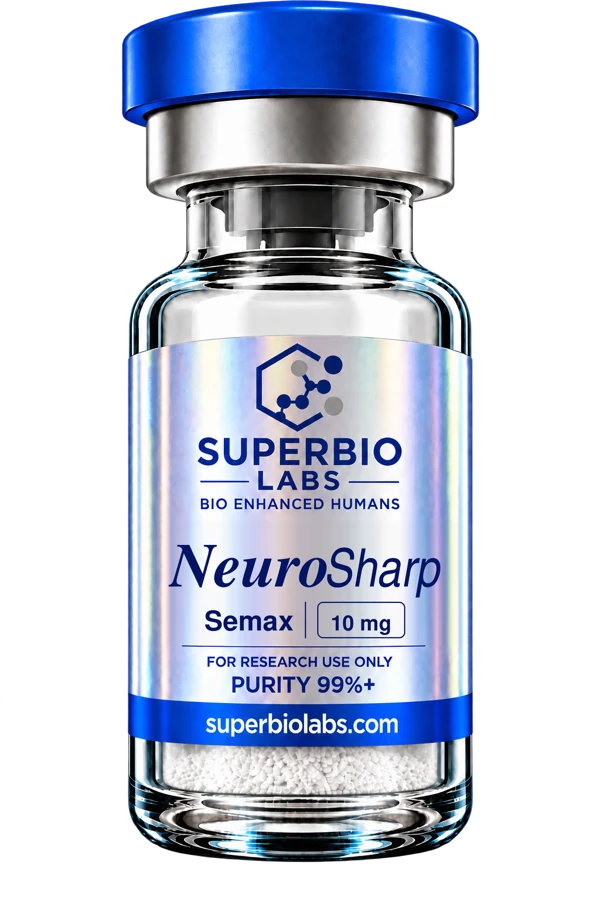 NeuroSharpSemaxAttention, memory and less mental fatigue · Neuroprotection: raises BDNF
- 2
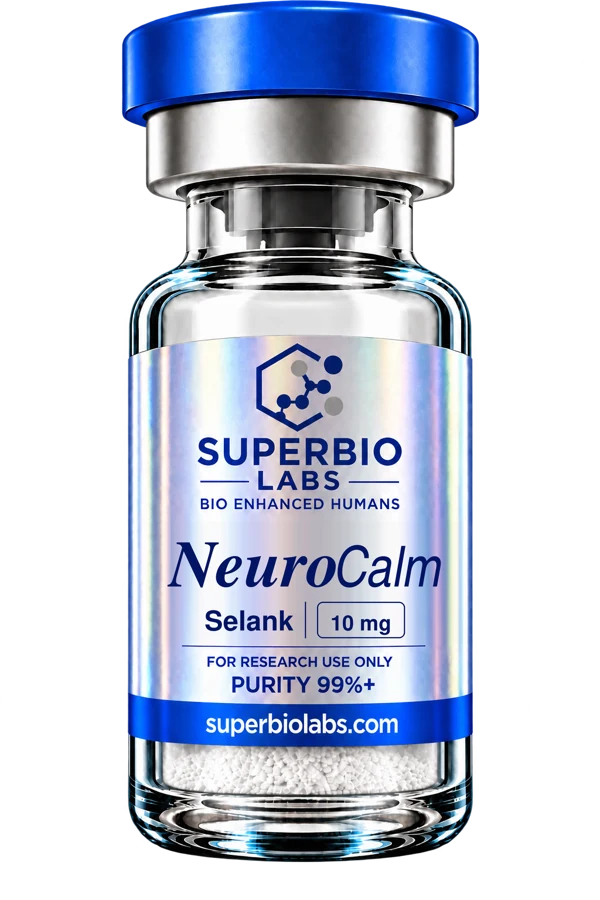 + NeuroCalmSelank+ Adds: Calms anxiety without sedation
Technical description.
Semax is a synthetic heptapeptide (Met-Glu-His-Phe-Pro-Gly-Pro) analog of the ACTH(4-10) fragment — the non-steroidal portion of adrenocorticotropic hormone. It was developed at the Institute of Molecular Genetics of the Russian Academy of Sciences in the 1980s and has been part of the Russian medical formulary since 1996 (for ischemic stroke and cognitive disorders).
SuperBio Labs Semax is supplied as lyophilized powder with verified HPLC purity ≥99%. Each lot ships with an independent Certificate of Analysis confirming identity by LC-MS, peptide content (98–102%), and endotoxin levels (<1.0 EU/mg).
Unlike classic stimulants (caffeine, modafinil), Semax has no hormonal activity: although derived from ACTH, it does not stimulate cortisol production. Its mechanism combines increased BDNF and its TrkB receptor with dopamine and serotonin modulation. In Russia it is an approved medicine (0.1% and 1% nasal drops) on the essential-drugs list. In 110 post-stroke patients it raised blood BDNF and improved independence (2018), and in healthy volunteers it improved attention and short-term memory (1996). Human studies are small and Russian; the newest data (2024–2025) are preclinical: in stroke rats it normalized over a thousand genes and in Alzheimer's mice it reduced amyloid plaques. It is not FDA- or EMA-approved.
Informed professional research use only.
Complete kit · ready to reconstitute.
Each order includes everything needed to use the full vial. No separate purchases required.
How to choose where to buy peptides.
This product meets all five — your batch COA ships with the kit.
Recommended application protocol.
The official protocol included in the kit.
Do not administer after 4:00 PM — it may interfere with sleep onset in sensitive individuals. If used nasally, alternate nostrils between doses to avoid local irritation.
What to expect · real timeline.
2-4 week cycle with cognitive response from day 1.
When to use Semax.
Focus for work or study
Attention and short-term memory improved in healthy volunteers, more so when fatigued (1996).
Students during exams
Short-term memory · 2-4 week cycle for exam season.
Cognitive recovery
Burnout, brain fog, post-COVID fatigue · raises BDNF in models; little studied in people.
Recovery after a stroke
110 rehabilitation patients: more BDNF and more independence (Russia, 2018).
Vision and optic nerve
Optic neuropathy or pressure-controlled glaucoma · Russian studies as add-on.
Cognitive aging
Memory and amyloid plaques in Alzheimer's mice (2025) · no human data yet.
Honest side effects.
Very well tolerated. Good safety profile over about 30 years of clinical use in Russia:
If used nasally: local irritation of the nasal mucosa (alternate nostrils, use divided dosing) · occasional nasal dryness · sneezing on first application · mild stimulation if applied late (avoid after 4:00 PM) · no documented increase in blood pressure · no studies measure tolerance; it is used in 2-4 week cycles with a 2-week break.
Technical specifications
| CAS number | 80714-61-0 |
| Molecular weight | 813.92 Da |
| Sequence | Met-Glu-His-Phe-Pro-Gly-Pro |
| Class | ACTH(4-10) analog |
| Origin | Russian Academy of Sciences (Institute of Molecular Genetics) |
| Purity (HPLC) | ≥99% |
| Format | Lyophilized powder |
| Quantity | 10 mg per vial |
| Endotoxins | <1.0 EU/mg |
| Storage | −20 °C, protected from light |
| Use | Use under professional judgment |